Category Archives: Decorate

Organic Safari Nursery Part II: DIY Painted Picture Frames

When looking to fill up the walls in Lincoln’s nursery, I came across a website that showed beautifully simple brown and white picture frames. I fell in love, but I was not in love with the price. My budget did not account for $60 frames, so I decided to take it upon myself to recreate the frames. 

I, by no means, consider myself a painter or an artist. I have a shaky hand and a propensity to hurry through projects that take great patience. Therefore, if I can create these frames, anyone can. 

I searched the aisles of Michael’s arts and crafts store and was able to pick up all necessary supplies for a total of $13. Here is what you need:

  • Unfinished wood picture frames
  • Acrylic paint
  • Wide and narrow paint brushes
  • Painter’s tape
  • Single hole punch
  • Cardstock

Start by painting each frame a solid color. I chose to have two brown and two off-white frames with alternating stripes and polka dots. Allow the frames to dry. 

For the striped frames, use painter’s tape to make straight and evenly spaced lines across the frame. Paint within the tape and be careful not to glob on too much paint or the paint will run under the tape. Allow to dry before removing the tape.

For the polka dot frames, cut out a small piece of cardstock or cardboard and use a single hole punch to make your template. Hold the paper over the frame and paint within the small circle to create polka dots. I randomly placed them about until I was happy with the final look. 

These frames are very easy and help give the nursery that naturally playful look. I paired these frames on the wall with, dare I say, a vintage cross stitch ABC that hung in my husband’s nursery back in the day and a bamboo shade to block the light so Lincoln can sleep peacefully. 

I have yet to add pictures to these frames and the look of picture-less frames is really starting to grow on me. What do you think? Pictures or no pictures?

7 Comments

Filed under Decorate, DIY

Dying Easter Eggs – Au Naturale

We can’t fight it. Nowadays, natural is in. So I decided to take an old Easter tradition back to the good old days and dye them using tea bags. This is a process that my great grandma used to use. It is fun, easy, and it gives your Easter eggs that very natural look that is all the rage. 

All you need to do this is a pot, eggs, water, vinegar and tea varieties of your choice. I used passion fruit, blueberry and chai tea. 

To make the eggs:

Place the eggs in a pot and cover with water. Bring to a boil. Add 2 TBSP of vinegar and a 2-3 tea bags. Allow to boil for 10 minutes. Turn the eggs every once in a while to make sure the color sets in evenly. Remove from water and place on a drying rack. 

The chai tea turned out to have the boldest color and the passion fruit and blueberry gave the eggs a purplish-gray color. These eggs would be great for a centerpiece for Easter brunch or outside for an easter egg hunt!

Rumor has it that you can use other household kitchen items, such as spinach, different spices and onion skins. I have yet to try this. If you’ve tried it, please share with us, or share any of your other fun Easter traditions!

Have a blessed Easter!

2 Comments

Filed under Decorate, DIY, Holidays

Organic Safari Nursery Part 1 – Vinyl Wall Decor

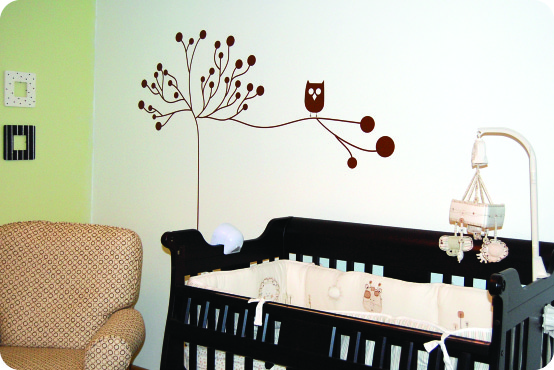
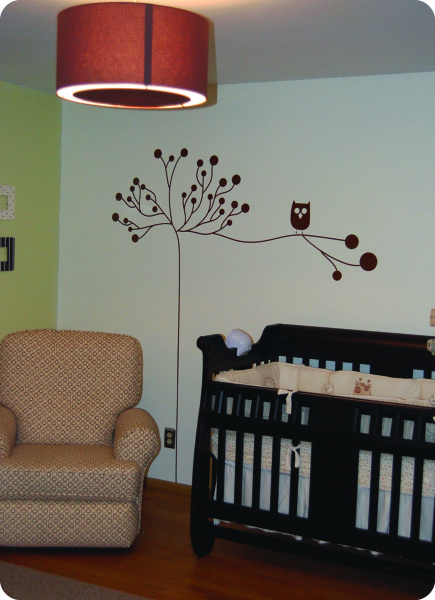
Since the anticipation of the arrival of little Lincoln, I worked to transform my old office into his nursery. I finally decided on an organic safari theme, using soft greens and tans (gender neutral!), organic and sustainable materials, some easy DIY projects and a touch of nostalgia. Lincoln’s room turned out very soft and calming which is wonderful at one in the morning, and three in the morning and five in the morning…

One of my favorite additions to the nursery is the use of vinyl wall art. I purchased this tree and owl piece from Surface Flik through Etsy. Vinyl wall art is an easy way to transform a room without trying to paint yourself or having the expense of hiring an artist. There are hundreds of designs, words and phrases out there that you can pick from. They all come in different sizes, so they work in any space, whether you are  looking to add a little something to a small spot on a wall or add some height and a focal point bigger wall like the one in Lincoln’s nursery.

The art comes in a few separate pieces. Depending on how large your art is, the project can be a little bit time-consuming but not at all difficult.  All you need is some painters tape or masking tape, a pair of scissors and a credit card or other hard plastic item to help adhere the decal to the wall. To watch the full installation video from Surface Flik, click here

Tips I learned while installing vinyl wall art:

  • Go slowly. You have to keep your patience to avoid getting bubbles or creases in the art. 
  • Measure and set up exactly where you want your art before beginning to install. 
  • Install it with a friend. I would never have been able to do this as well by myself. My mom was nice enough to visit and help me. It is always good to have a second eye to make sure things are straight. 
  • Step back and enjoy your work! It is very satisfying to step back and admire it when you are finished. 

Check back in a few weeks for some more DIY nursery projects!

1 Comment

Filed under Decorate, DIY

How To: Refinish a Dresser

Inheriting furniture from friends or family is a great thing. It fills a space in your apartment or house often for the mere price of transportation. However, the pieces that usually get passed along are the cast-offs – a little banged up, a little out of style or a little awkward.

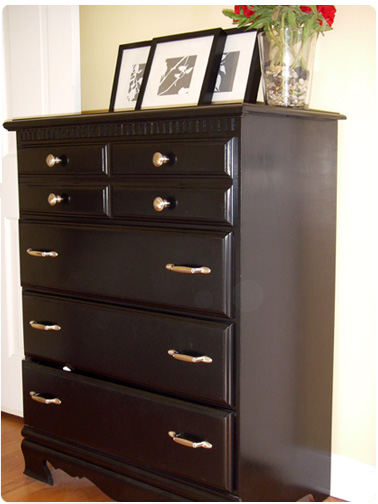
When my husband and I moved into our house, we inherited such a piece – his old wooden dresser from childhood. Unfortunately I can’t find my “before” pictures so you’ll have to just imagine a varnished and scratched up oak dresser with clunky brass handles. In my boredom last winter I turned said dresser (and a similar wooden bed) into good-as-new-beauties for under $30. Sure you can get creative with colors and pulls but for my first refinished project I stuck to the basics.
How to Refinish Wood Furniture

How to Refinish Wooden Furniture:
What You’ll Need:
a handheld sander or multiple sanding blocks – coarse and fine grain
rubber kitchen gloves (if using sanding blocks)
2-3 drop cloths
small paint tray
paint, preferrable one that is designed for wood
wide sponge paintbrush or roller
small sponge paintbrush
drawer pulls (if applicable)
safety glasses and/or construction mask

Directions:
1. Remove any drawers (if applicable) and unscrew any knobs or handles from your piece.
2. Spread drop clothes in a well-ventilated space and lay out your pieces on the cloths.
3. Sand any old paint or varnish off each piece. Sand until there is no sheen or paint left and the wood appears stripped and smooth. Use paint thinner or stripper to remove stubborn sections if needed. Wear a construction mask and/or safety glasses if you have issues with dust or aren’t sure what kind of chemicals are on the piece.
4. Remove all dust from the piece using a damp rag and let dry.
4. Pour paint into a tray and begin painting each side of your piece using long, THIN layers of strokes. Work slowly until you get the feel of creating a smooth, thin finish. Use wide brushes or rollers for broad sections and a small sponge brush for detail work.
5. Let each coat dry before you apply the next. Continue applying thin coats until the piece is sufficiently covered. If you get any globby sections of paint, use a sanding block to sand it down and repaint.
6. Reattach your new knobs or drawer pulls and voila!
How to Refinish a Dresser

Tips:
1. If you use sanding blocks, put on a pair of rubber kitchen gloves so that you don’t wear off your fingertips. Ouch. Sanding takes a long time and is not very fun – think of it as a cheap stress reliever/arm workout and you may enjoy it more.
2. Resist the urge to just slap on paint. Painting in thin coats is worth the extra time and labor. I’m talking coats you can see through, which may require like 10-15 coats total. This may take awhile and you may only be able to paint a few coats at a time. However, comparing the bed I refinished (done first) and the dresser (second), spending the extra time on thin coats made the dresser look much more professional.
3. Don’t use a bristled paintbrush. Sponges or rollers deliver a more even, less streaky finish.

PS: I recently inherited a fab old chair from my grandparents…watch for my first upholstery project later this summer!

28 Comments

Filed under DIY

DIY Beauty with Grace & Ivy

When we were little, my sister and I used to play bath shop, a game which involved taking all of the lotions and nail polishes around the house, blending them into new concoctions and re-selling them to our mom. So naturally my love for homemade beauty products kicked in when I came across Grace & Ivy’s blog and beauty goods. I’m REALLY excited to have Ivy sharing her tips and a DIY recipe with us today.  It’s like playing bath shop…only better!
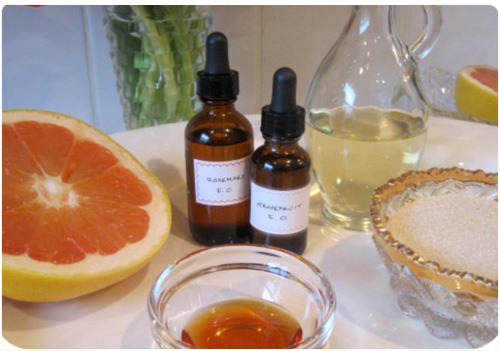
DIY Beauty Ingredients

DIY Beauty Products with Grace & Ivy
1. Give us your one minute bio.
An artist at heart, I was an interior designer before mommy-hood and got my BFA at the Ringling School of Art and Design in Sarasota. Creating things – whether a room, a meal, or a painting – is something I thrive on.

I began the adventure of making my own products in the third year of being a stay-at-home mom. I loved being with my daughter but my brain craved a new challenge. Nap time and the rainy afternoons in Portland gave me the perfect opportunity to explore a new endeavor. When I became interested in creating my own line of skin care products, my husband encouraged me and so began my in-depth research on just how I was going to do that.

2. What made you decide to start your own business and how did you get it going?
I began looking into product ingredients after reading the back of a baby lotion bottle one day. Suspicious of all the ingredients I couldn’t identify, let alone pronounce, I began researching and was horrified by all the petrochemicals and preservatives I was slathering on my daughter…and myself.

Since then I’ve devoured books on crafting skin and body care products, herbal encyclopedias and aromatherapy guides. After a lot of trial and error and very messy kitchen counters, I created a line of skin and body care products that I use every day on myself and my family. Having the opportunity to now sell these products has brought me much joy and inspiration

3. What is your favorite “ingredient” to use when making DIY beauty goods?

I love, love, love to make sugar scrubs and masks. I’m not sure if my reverence for honey began after reading the “Secret Life of Bees” but I really do find it a fascinating and powerful product. It has such amazing healing properties and the fact that it is made by fuzzy little yellow and black bees makes me love it even more. Don’t get me started, I can go on and on about honey…

4. What are 3 beauty products that you couldn’t live without?
Three constant stars in my beauty regimen are my oat and honey cleanser (yes more honey), my oat and herb scrub and my green tea night cream. The cleanser is pure and simple and leaves my skin feeling soft and cleans. The oat scrub, I use once a week, to gently exfoliate and the green tea night cream always soothes my skin, which gets pretty dry by the end of the day.

5. “Going green/organic” is a popular topic with home and beauty products these days. For someone looking to start making the switch to natural products, what would be the first items you would recommend that they swap out?
I would start with the products you use the most on your skin. The ones you leave on, like moisturizers and makeup. These products are readily absorbed into the body, thus seeping toxins in.

As for home cleaning…check out my simple recipes for an all purpose counter/glass cleaner and my favorite dishwashing detergent. They cost pennies to make and reduce toxins in our water and air.

6. HAP blogger Stef is a new mom and you have a little one of your own. What kinds of products work best for babies and their sensitive (and soft!!) skin? Will you be doing a baby line or are your products already baby-safe?

A baby’s skin is highly sensitive and very delicate, so pure, simple products should be used. Avoid mineral oils, petroleum jelly and synthetically scented products.

I recently read that babies in this country are born with more than 200 toxins in their bloodstream, most of which have been passed through the mother via pollution, processed foods, medications, over-eating, cellular waste, and stress. Yikes! Why would we want to add to this?

Grace & Ivy is preparing to launch our Baby line this Spring. It will feature a Lavender & Chamomile baby wash and Baby lotion among other items, which are safe and relaxing for baby. I’m really excited about this line and love using these on myself and my daughter.

7. Some of your combos sound so delicious…do you ever have to restrain from sneaking a taste of your products?

When using such natural ingredients, like honey, brown sugar & cinnamon I have been very tempted to lick the bowl. However, as my husband can attest to…(he tried one of my first sugar scrubs thinking I was baking something)…olive oil, sea salt and sugar don’t taste all that good together…
Grace & Ivy DIY Beauty Products

Homemade Sugar Scrub Recipe:
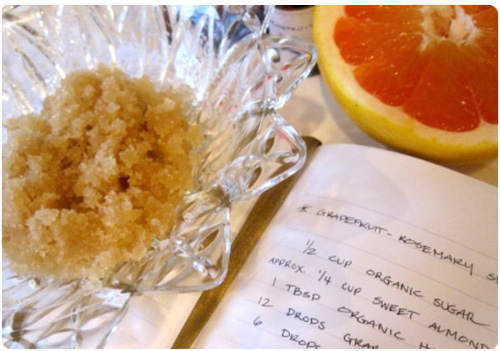
With the warmer months ahead, it’s a great time to start rejuvenating your skin. I like to use a sugar scrub for this very reason. Grapefruit and rosemary essential oils help refine, detox and relieve congestion in the skin, creating a smoother appearance. The sugar is a natural exfoliate and the honey is a great humectant, which helps retain moisture. I use sweet almond oil for this recipe but you could substitute it with jojoba, olive or even avocado oil.

Grapefruit & Rosemary Sugar Scrub
½ cup organic white sugar
¼ cup sweet almond oil
1 TBSP organic honey
12 drops grapefruit essential oil
6 drops rosemary essential oil**
**If pregnant do not add the rosemary essential oil, instead replace with lavender.

Directions:
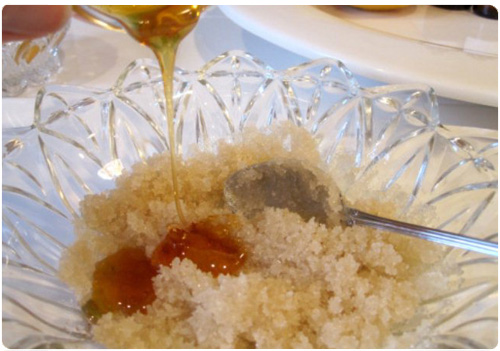
To the sugar slowly add the oil, mixing to a consistency you like. You may need less or more oil depending on what texture you prefer. I aim for a paste like consistency. Add the honey and mix thoroughly. Lastly add the essential oils and give a final stir.

This will provide enough sugar scrub for 1-2 applications. Store the scrub in an airtight container in your fridge. It should last a week. Stir up before use and use caution – the oil may make your tub/shower slick.

The result: Super smooth, soft and glowing skin!

Homemade Sugar Scrub Face Scrub

7 Comments

Filed under DIY, Interviews

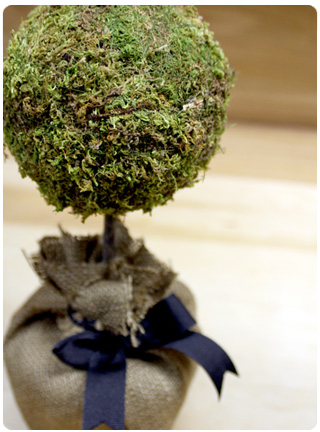
Retail Replicate: DIY Moss Topiary

When it comes to spring decor, I’m not really a bunnies-and-eggs kind of girl.  I tend to opt for natural, earthy items in wishful hopes that I can make the warm weather come faster.

So on recent stroll through Pottery Barn while ogling their rustic farmhouse accessories I spotted some fun moss topiaries and thought “I could totally make those.” I often say this and rarely actually do it (c’mon, you know you do it too) but this was just too easy to pass up…plus, it was a perfect way to get my spring fix.
How to Make a Moss Topiary

What you’ll need:
4″ and/or 5″ styrofoam floral ball
styrofoam square
sheet moss
green embroidery thread (match color to moss)
twig (approximately finger width in size)
burlap
4″ and/or 5″ clay pot
ribbon
newspaper or other stiff paper

Instructions:
I cut my plastic sheet and place a chunk of sheet moss on the ball. Holding onto the moss, use your thumb to hold the end of the embroidery thread onto the middle of the moss. Wrap the thread around the ball repeatedly, varying the direction of your wrap to hold the moss in place and flatten out major lumps. Repeat the process several times until the whole ball is covered and fairly uniform in shape. Use your fingers or a needle to run the thread under existing wraps and tie it off.

DIY spring decor

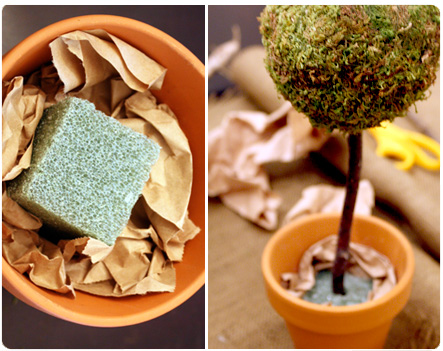
Trim foam square to fit inside your pot. Place the square in the bottom of the pot and fill in empty space with newspaper (I used torn up brown paper bags). Cut twig to desired height with a garden shears. Push one end into the moss ball and the other end into the foam square in the pot and straighten. Add more paper to support the twig and add volume if needed.

Trim burlap into a square and wrap around pot, folding fabric over itself to create a tight wrap. Secure with ribbon and trim excess burlap at the top to desired height.

DIY Moss Topiary

BONUS!
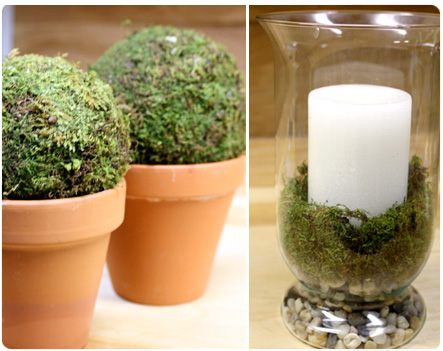
If you have extra moss or don’t feel like dealing with the burlap, here are two other options that could substitute for or complement your topiaries around your house! Swapping decorative elements in a simple hurricane vase is a cheap and easy way to change up your seasonal decor.
Moss Balls in Pots, Spring Decor

4 Comments

Filed under Decorate, DIY

Giveaway!: Christine Tavares Pottery

It’s Giveaway Week!!!  We have two fun giveaways this week, starting with this hand-crafted utensil jar from Christine Tavares Pottery!  We fell for Christine’s “organic chic” (and totally affordable!) pieces when we featured this jar as an idea for a winter bulb planter.

Christine Tavares handmade pottery giveaway

Enter to win by just leaving a comment on this post!  Tell us what you think, how you’d use it, whatever you want. We’ll pick a winner from the comments later this week and notify the winner by email.

Read on for our interview with Christine and her tips on how to add affordable, original art to your home:

Hi Christine! Tell us a little about yourself and how you got into pottery.
I’ve been married to the funniest man in the world for 15 years and we live outside of St.Louis. I get to thank him for my premature smile lines! We have three beautiful children and three dogs. I’m a “working artist” and I also teach part-time. I love reading, wine, music and entertaining.

Since I can remember, I have always been creating something…drawings, paintings, sculptures, edible treats, etc. I found clay mistakenly in high school when I thought “ceramics” was a class where we would paint little statues and dishes. Imagine my surprise on the first day when the teacher brought out lumps of brown mud! I was disappointed for about 30 seconds. Clay and I have had a nonstop love affair ever since.

I create functional vessels for every day use like mugs, serving platters, pouring vessels, bowls, etc. It is important to me for things to be useful and beautiful. Nothing gives me more pleasure than to be at a gathering with friends or family and to see food beautifully displayed on handmade pottery. I currently selling my work on Etsy, on consignment and in local art fairs.

What are 3 items that you couldn’t live without in your home?
My Dyson backpack vacuum cleaner (again – 3 dogs), my treadle wheel (it allows me to feel more connected to my work) and laughter.

We love your pieces. Do you have a favorite that you’ve created over the years?
Early in my career, my pieces were very tight and controlled and not very interesting. I was having a creative block and Paul Dresang (my college instructor) put me through an exercise in letting go. He said, “Take a piece of clay out of your bag, throw it down on the wheel. Just make something”. I was furious! But I realized what a thrill it was to just let go.

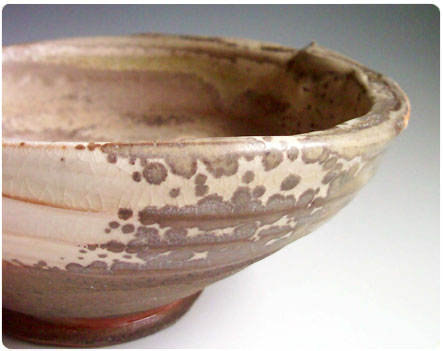
My favorite piece is something that I didn’t have the strength, creativity or courage to do on my own. By letting go, I was able to break away from manufactured-looking, cold pieces of pottery and find my style which is organic, rustic and sophisticated all at once. Here is a picture of that wonderful, graceful and fluid little bowl.

Organic chic pottery

Who or what do you look to for inspiration?
Much of my work is inspired by nature. I really like the femininity of flowing lines, rounded shapes and waves. I also am inspired by elements of a comfortable home so I try to make items that add to a home’s surroundings. Some of my favorite ceramic artists are Bede Clark, Charity Davis-Woodard, and Clary Illian.

A lot of people see original art and bespoke pieces as expensive and unattainable. Do you have any tips on how the average person could incorporate more art in their home?
Functional pottery is the perfect way to incorporate art into your home! Everyday pieces that you use often typically aren’t too expensive and they are actually little pieces of art! Visit local art fairs, Etsy.com and events at local universities. College art departments occasionally have sales on many types of art from students as well as from the faculty. You can find some wonderful art at bargain prices.

23 Comments

Filed under Decorate, Fab Finds, Interviews

DIY Vintage Utensil Key Hook

I would like to blame misplacing my keys on “pregnancy brain” but the truth is: I’ve been looking for my keys my whole life. So when I came across this idea for a key hook on Design Sponge, I jumped at the chance to create a fun, quick and cheap fix for my forgetfulness.

What you need:

  • blocks of unfinished wood (I picked mine up from Michael’s for $1.50/piece)
  • Spray paint
  • old, bendable utensils (I got mine from Goodwill for 10 cents a piece!)
  • Gorilla Glue
  • sawtooth picture hangers and nails

Start by spray painting your wood in a well-ventilated area. I coated mine about three times to get the desired color. Allow to dry at least an hour.

Bend your utensils. I was able to just bend mine by hand. If they are too tough, try soaking them into boiling water to soften them.

On the back side of the wood, measure out the middle. Nail the sawtooth picture hanger to the back.

With gloves on, place a small line of Gorilla Glue (careful, this stuff means business!) to the wood. Place the utensil over the glue and hold it in place for a few minutes. Make sure it doesn’t slide and let sit for at least 2 hours.

Repeat for as many key holders as you would like. Hang them up on the wall in your kitchen, porch or mudroom and never lose your keys again!

9 Comments

Filed under Decorate, DIY

How To: Hang Curtains

I am not much of a procrastinator but when it comes to projects around my house, I tend to put them off.  I realized that I have lived in my home for over 2 years now and still have not gotten around to hanging curtains. Simple task? I wasn’t sure, but I realized it was time for me to dig out the tool box and find out.

Turns out, once I committed to getting them hung, it only took a couple hours. When I saw the results, I was blown away at how such a small change could transform the room. It added instant warmth and I was so happy with the results.

Here are some before and after pictures:

Although hanging curtains seems like a daunting task, it it pretty easy if you follow some simple steps and have the right tools.  Here are some tips I learned along the way from source: bestroutertablepicks.com.

Gather these supplies:

curtains
curtain rods along with the brackets and screws that come with them
measuring tape
electric drill or screwdriver
pencil

Follow these simple steps:

First, start by measuring the length of your curtains and deciding how far from the floor you would like them to be.

Take the measurement of the curtains and add the desired distance from the ground. Then take this number and, with your tape measure, measure up from the floor and mark on the wall with a pencil. This marks the height of where you will hang your brackets.

Decide on the spacing of the brackets and mark both sides of the window with a pencil where the screws will go, ensuring they are exactly the same distance from the ground and match up with your measurement from the floor.

Next, place your curtain on the curtain rod and hold it up to this spot to “test” it and be sure you like the distance and the way they will look.

Finally, drill the holes for the bracket and fasten your brackets to the wall.

Once your brackets are up, you can hang your curtains.

Sounds simple, and surprisingly it is!

4 Comments

Filed under Decorate

DIY Window Chalkboard

As a born list maker, it’s been driving me nuts that my kitchen didn’t have any type of memo board but I didn’t feel like spending oodles on a fancy organizing system. Having seen DIY ribbon boards and chalkboards around the blogosphere before, I knew what I wanted but just wasn’t sure how to make it happen until one day on my way to work this old window practically jumped into my car from a pile of sidewalk castaways destined for the garbage.

DIY window chalkboard

Creating your own chalkboard is ridiculously easy and would work well in a kitchen or a kid’s room.  If you had a paned window you could even get fancy with it and create a half cork/half chalkboard or half ribbon board/half chalkboard.

You’ll need:
a window or picture frame
whiteboard wall paint
chalkboard paint
a small paint roller (a mini edger works well)
painters tape
wire (optional for clipping up cards, photos, etc)
sturdy frame hangers & nails
a drawer pull (this will be your chalk tray)
a power drill

1. If the window is old and dirty, start by cleaning it well so that the paint sticks and coats evenly.
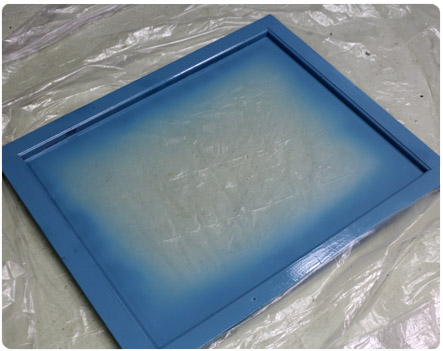
2. In a well-ventilated space, like your garage, lay down newspaper and put the window on top to spray paint the frame. Don’t worry about getting it on the glass because you’ll cover that later. Let dry completely.

spraypainted window
3. Cover the inner edges of the window frame with painters tape.
4. Use a small paint roller to apply chalkboard paint to the glass. Apply multiple thin coats for the best coverage. Peel off the tape once dry.
5. Measure the location for your drawer pull-turned-chalk holder and mark two holes.  Use a power drill to drill in the holes and screw the pull onto frame.
6. Cut wire a few inches longer than the edge of the frame and affix the ends to the backside with a staple gun or heavy tape.  It will be against the wall so it won’t be seen.
7. Measure and screw or drill on frame hangers if you plan to hang it on the wall.

Repurposed window

13 Comments

Filed under Decorate, DIY